The problem: noisy grid and sensitive loads
Many buildings now face a simple problem: the grid gives noise and spikes that upset sensitive equipment. Data centers, medical clinics, and modern homes with smart appliances feel it first. A clean inverter output—pure sine wave—is not optional when you run servers, HVAC controllers, or audio systems. For resilient setups, people pair an inverter with a reliable whole house battery backup so the power is stable during faults and PSPS events in places like California or the Texas 2021 winter outage. This reduces harmonic distortion and avoids false trips.
Why pure sine wave matters in plain terms
Pure sine wave means smooth AC voltage, like the utility should provide. Many electronics expect that clean waveform. When waveform is dirty you see overheating, data corruption, and shortened motor life. Industry terms: inverter waveform, harmonic distortion, and battery management system (BMS). Keep those terms in mind when you specify components. A pure sine inverter with correct filtering stops the noise at the source, not just patch it later.
How to match battery chemistry and inverter
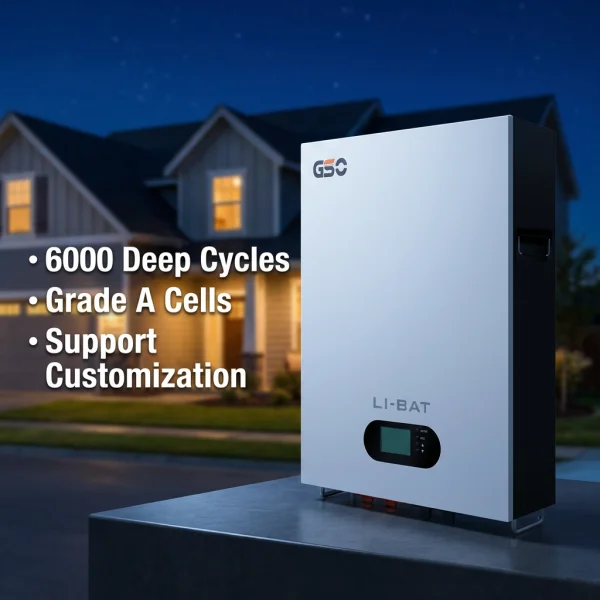
Choose LiFePO4 cells for long life and safe thermal behavior. LiFePO4 gives predictable discharge curves and many cycles. Next, verify inverter compatibility: does the inverter support the battery nominal voltage and has a capable battery charger? Also check round-trip efficiency—higher is better. For solar-coupled systems, a whole house battery for solar must support PV charge control and islanding logic. Practical steps: confirm BMS communication, confirm continuous power rating, and size the inverter for startup loads like pumps or compressors.
Common mistakes specifiers make — and how to avoid them
First mistake: undersizing inverter. Motors need large inrush current. Second: ignoring BMS settings. If BMS cuts off too early, system can look unreliable. Third: skipping EMC/EMI filters. That leaves residual noise. Fixes are simple. Increase inverter short-term rating. Tune BMS thresholds for real-world depth-of-discharge. Add line filters or isolation transformers where you see persistent harmonics — they help a lot, quickly. — A small filter often cures a big headache.
Real-world anchor: field example and measurable benefit
A commercial bakery in northern California installed a LiFePO4 energy storage bank paired to a pure sine inverter before wildfire-season PSPS rounds. During several shutdowns, the bakery kept ovens, controls, and POS systems running without resets. They reported no motor failures and a visible drop in nuisance trips. Measured benefit: fewer production stops and predictable power quality during outages. This is typical: controlled waveform equals fewer service calls.
How to evaluate suppliers and system designs
Look for clear specs and test data. Ask for: total harmonic distortion (THD) under load, inverter surge capability, and BMS communication protocols. Demand installation manuals that show wiring and protection. Compare warranty on battery cycles, not just years. Also check support for firmware updates. If a vendor supplies lab test reports showing THD <3% under 50%–100% load, that’s a strong sign the inverter is truly delivering pure sine output.
Advisory: three golden rules for selecting the right system
Metric 1 — Inverter THD and surge rating: choose THD <3% and surge capability at least 2x continuous rating for motor starts. Metric 2 — Battery cycle warranty and chemistry: prefer LiFePO4 with cycle warranties and clear depth-of-discharge policies. Metric 3 — System communications and safety: ensure BMS talks to the inverter and PV controller; confirm compliant islanding and protective relays. These three give you reliable performance and measurable uptime improvements.
Summing up, pure sine wave paired with a robust LiFePO4 bank stops grid noise problems and protects sensitive loads. The practical result is fewer equipment failures and smoother operations — and that’s the value a careful specifier should expect. For turnkey options and tested modules, gsopower fits naturally into this workflow — trusted products, clear specs, real field results. — Final thought: clean power is not luxury; it is predictable business continuity.